Look at the market on any given day, and it reads like noise. Thousands of tickers twitching up and down for no reason you can see. Ask a traditional analyst why one stock jumped 5%, and you get a company story: an earnings beat, a product launch, or a new CEO.
That story is usually true and usually incomplete.
Stocks don't move alone. They get pushed around by large, shared currents called factors. And here is the part most explainers skip: the strongest current in today's market isn't value, or growth, or quality. It's the flow of passive money itself. I'll come back to that at the end, because it changes what the whole picture means.
To see what a factor is without drowning in quant notation, step away from Wall Street for a second and look at the thing on your wrist.
The biometric lens
A fitness watch tracks your raw vitals: heart rate, blood oxygen, sleep stages. When your pulse spikes on a morning run, the number on its own tells you nothing. Was it a steep hill? Just your age-group baseline? Or something genuinely worth a doctor's attention?
Portfolio managers have the same problem with returns. A stock is up 3% today. So what?! Factors are the market's biometric markers, the structural readings sitting underneath the raw number. Here is how the two line up:
Health telemetry
Financial factor
What it does
Vital sign streams raw biometrics: pulse, VO2 max, HRV
Asset return streamY
The raw, unedited timeline of an asset's daily returns. The baseline before any filtering.
Scores each asset on its structural traits (value, growth, quality) and the baskets it belongs to.
Baseline fitness for your demographic expected performance for your group
Factor returnsβ
The reward or penalty the whole market hands out for carrying that trait, not for your own choices.
The unexplained anomaly a spike no baseline accounts for
Idiosyncratic alphaε
Your actual skill. What's left after every shared factor is stripped out. The part an index can't sell you.
Return, in plain notation: Y = X β + ε — what you earned (Y) is the factor exposures (X) times their market payoff (β), plus the bit that's truly yours (ε).
How the filter works
When a runner posts a fast mile, a decent coach splits the result in two: how much came from a tailwind and a downhill, and how much from the runner's own engine. Only the second number tells you anything about the athlete.
A factor model does the same thing to a portfolio. Earn 20% in a year, and the model strips out the tailwinds first: a broad rally in cheap stocks, a hot sector, a market-wide rotation into momentum. Whatever survives that subtraction is the return you can actually take credit for.
That leftover is idiosyncratic alpha: the slice of performance that came from genuine insight, the slice a cheap index fund can't hand you for free.
That leftover is idiosyncratic alpha: the slice of performance that came from genuine insight, the slice a cheap index fund can't hand you for free.
Why allocators care
Large institutions don't want to pay hedge-fund fees for returns a robot could deliver. You can buy broad factor exposure, a basket of low-volatility names or high-growth ones, through a passive fund for a few basis points. So why pay 2 and 20 for the same tailwind?
That is what factor models are really for. They draw a hard line between borrowed performance and earned performance, and they make a manager prove the edge is real before serious capital chases it.
The takeaway: the biggest factor is now the flow itself
💯
Passive investing is a sensible choice for most retail savers. The catch is what those flows do to the market once they get big enough:
Money moves by weight, not by judgment. A passive fund buys every name in the index in proportion to its size, whatever the price. The bigger a company gets, the more index money flows in, which makes it bigger still. Valuation never enters the decision.
Flows move prices more than you would expect. Gabaix and Koijen's inelastic markets work estimates that a single dollar moved into equities can lift total market value by roughly five. Price is set at the margin, and the marginal buyer increasingly isn't reading the fundamentals.
Stocks start moving as a herd. When index members get bought and sold as one basket, their returns correlate more tightly. That shrinks the idiosyncratic dispersion, which is the exact thing the factor model above is trying to isolate. The tool and the market quietly bend each other.
Price discovery thins out. Every indexed dollar is a dollar not voting on whether a company is cheap or dear. Fewer price-sensitive hands set the level for everyone. Michael Green has pushed this point hardest: at some passive share, who is left to do the pricing?
Step back, and the same lesson turns on the market itself. What people see is shaped by the structure underneath: the defaults, the rules, the path a behavior takes through a network. Passive investing is that idea in the wild. A default (your workplace pension, the auto-enrolled fund, the cheapest option on the platform) became a cascade, and the cascade now shapes the prices everyone reads as "the market."
Zoom out one more level, and the same shape shows up in the plumbing. The offshore dollar system, the eurodollar market, repo, collateral are another hidden current most people never watch. They track the price (the index level, the headline) the way the rookie analyst tracks a single stock. The lesson holds all the way up: the number on the screen is downstream of forces you have to go looking for. The flow is the factor.
So: factors are filters. They strip away the shared currents so you can see what is genuinely yours. The twist in 2026 is that one of those currents, passive flow, has grown big enough to move the whole sea. Learn to read the factor, and you stop mistaking the tide for skill. That holds for a single portfolio, and it holds for the market as a whole.
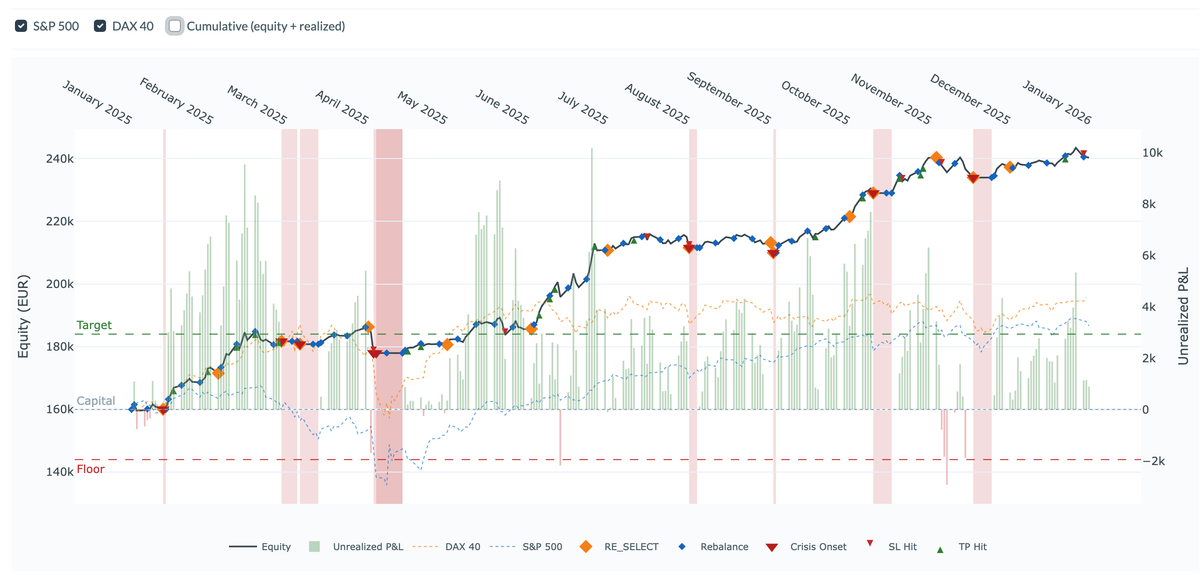
Disclaimer: The title image is a simulation. It would be too good to be true otherwise... wouldn't it?
The link has been copied!
Your link has expired. Please request a new one.
Your link has expired. Please request a new one.
Your link has expired. Please request a new one.
Great! You've successfully signed up.
Great! You've successfully signed up.
Welcome back! You've successfully signed in.
Success! You now have access to additional content.