COBESY tells you why adding content to a motivation or environment gap makes things worse. Everybody can use AI for slides and business slop. Few people know how to go beyond that in their organizations and move forward collectively.
This morning in the shower I had an idea. Four what-ifs, really:
what if organizational decisions and fomo (fear of missing out) run on the same wiring
what if group psychology and the way organizations actually decide are the same problem
what if leadership and how change spreads come down to herd instinct and who talks to whom
what if motivation at work and the social stuff around it trace back to one principle
Situation Normal, All Fucked Up (SNAFU) isn't a law of nature. It's just what you get without a method. COBESY is the method.
Intro
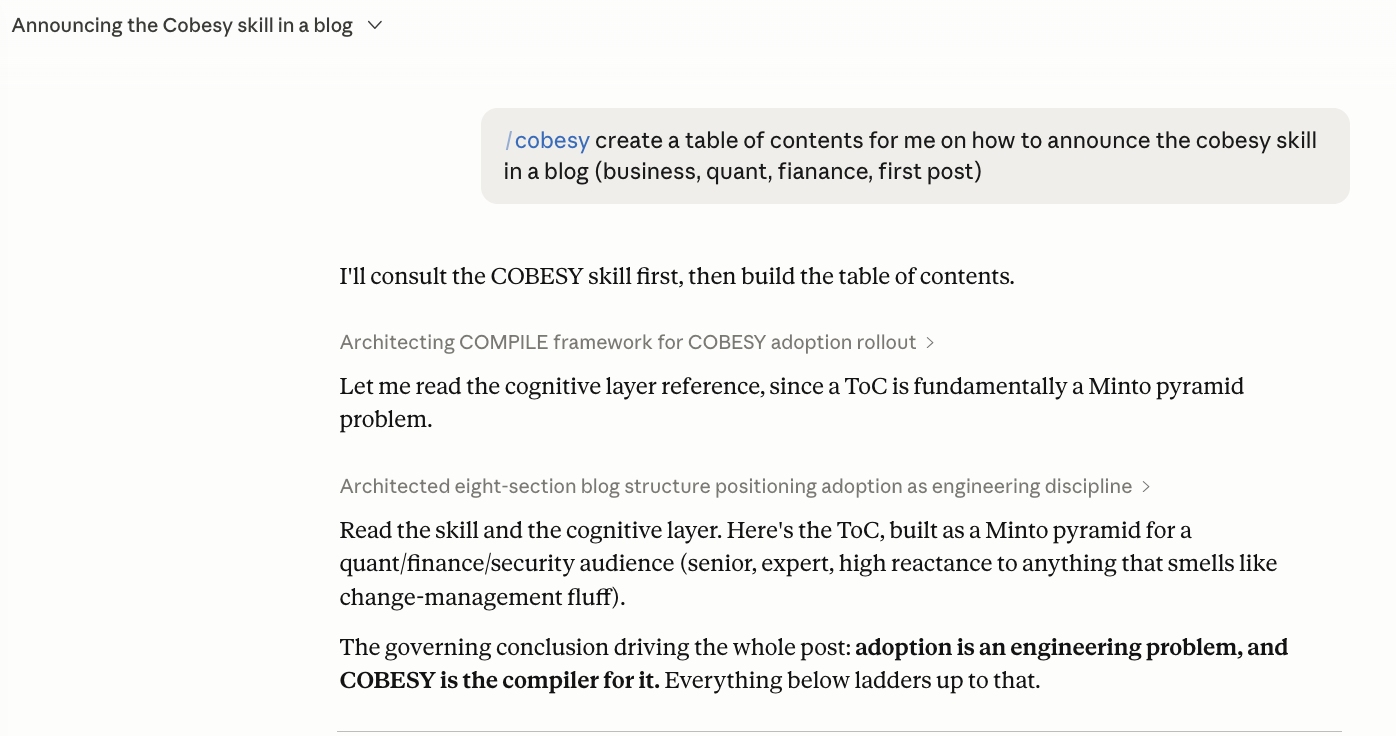
COBESY stands for Cognitive, Behavioral, Systematic. It takes knowledge and turns it into something an organization can actually adopt.
And if it works, I should be using it on this very post. I am. So read it twice: once for what it says, once for the way it's built.
The dead deck
Remember Prezi? Your last Miro board. Canva. PowerPoint. Boooring. Here is the part nobody admits: explaining it better keeps failing. New template, fails. Animation, fails. Brighter colors, fails. Saying it slower and louder, fails too.
You misdiagnosed the gap: Storytelling isn't the solution
The gap was never about clarity. Or story. Or hooks. COBESY shows you why pouring more content into a motivation gap, or into a broken environment, makes things worse instead of better. Stories, hooks, rapport ... all of that can fall onto deaf ears.
static knowledge → AI agents → operate
COBESY
Three layers
Cognitive
Behavioral
Systematic
You read them top-down, because that is the order the audience meets them. You build them bottom up, because the culture decides whether any of it survives. So we work upwards.
Systemic base
Schein and Edmondson. Whether the idea survives the culture it lands in. Get this layer wrong and nothing stacked on top of it matters.
Behavioral vectors
Centola, Jackson, Berger. How it spreads. A simple fact jumps on a single contact. A costly change in behavior needs repeated contact from people you already trust. Most real adoptions are the second kind, which is exactly why the all-staff email does nothing.
Cognitive interface
Minto, Dirksen, Knowles. What the audience actually sees: the message, squeezed down to fit a working memory and an adult who already knows a few things.
What you actually get
The skill hands you two things:
A rolling framework that walks a skeptical desk from zero to bought-in.
A way to talk to the Elephant, not just the Rider: the gut, not only the spreadsheet.
Everybody can create AI slides.
Few can structure them
The validation gate
Before anything ships, it runs six checks:
MECE: no overlaps, no gaps
Working memory: it fits inside one human head
Safe to say: the room can actually hear it
A disproof condition
Cascade, not broadcast
Removes a barrier instead of pushing harder
That fourth one carries the most weight. Every claim ships with a "we are wrong if ___". That single line is what separates a method from motivational fluff.
And to be clear about what this is not: it is not coaching, and it is not a team-building offsite. You will not dance your org into AI readiness.
What it does deal with:
how behavior spreads
what makes an idea stick
how a group warms to something
how a person’s place in the network decides whether your content even gets heard
When not to use it
Skip it for:
factual lookup
a single-fact answer
anything with no human adoption problem
If nobody has to change their behavior, COBESY is just overhead.
The skill is free. Here is the one thing I would ask: do not read it and nod. Pick a single rollout you are stuck on right now. A tool nobody opens, a process that will not stick. Run it through COBESY once. One real problem. That is the whole experiment.
Attribution is here. The idea came out of a Wharton seminar on where this generation of AI agents falls short. I had just added the Gartner ReFlect skill to my collection and started asking what I needed next.
Blueprint for building AI for business adopters
Enthusiasm fades, a changed environment does not
COBESY curbs the hype and answers the objections you would actually raise:
It is not decorative. No AI slides, no template theater.
Knowledge versus skill: the spine is real research, not vibes.
Proximity beats completeness. Put the structure where the work happens.
Cognitive load: 7±2, Minto, the anti-cringe gate. Nobody enjoys the chicken-dance offsite.
Environment beats motivation hacks:
it is not built for a quick pitch that insults the room’s intelligence
it is built for a transformation, because a changed environment is what carries a cascade once the enthusiasm wears off