

Aug 11, 2026
3 min read
I know... no one cares about the prop trading game. Unless... you look at it like a proofing ground with its own survival rules. Like poker. Just a bit more academic, if you would allow...
And no, this isn't for the peer reviewed academic quant journals. Or for the masses. Being independent allows me do research controversial, new or simply interesting things. Things that don't make money yet.
The whitepaper is grounded, like the actual paper. By intention. Applying the following over standard CPPI position sizing can be calibrated intelligently. And result in better risk control. With very little cost.
Even quants may underestimate the operational challenges with integrating alpha strategies. The mindset is to improve the returns per unit of risk, not to seek for high a CAGR that doesn't scale. This CPPI optimisation is part of a framework, that does exactly that.
The mechanism here answers one question - how much total risk to deploy. Separately from the alpha stack that decides what to hold (over the time until the rebalance is scheduled).
Simulation-Based, Risk-Aware Position Sizing for Volatile Markets: A Monte Carlo CPPI Approach with Threshold-Tiered Survival Ranking
The loss function of a levered book under a survival
mandate is asymmetric: oversizing ends the account,
undersizing only forgoes return. This paper documents
a position-sizing mechanism that prices this asymmetry
by simulation, and reports an honest negative on its
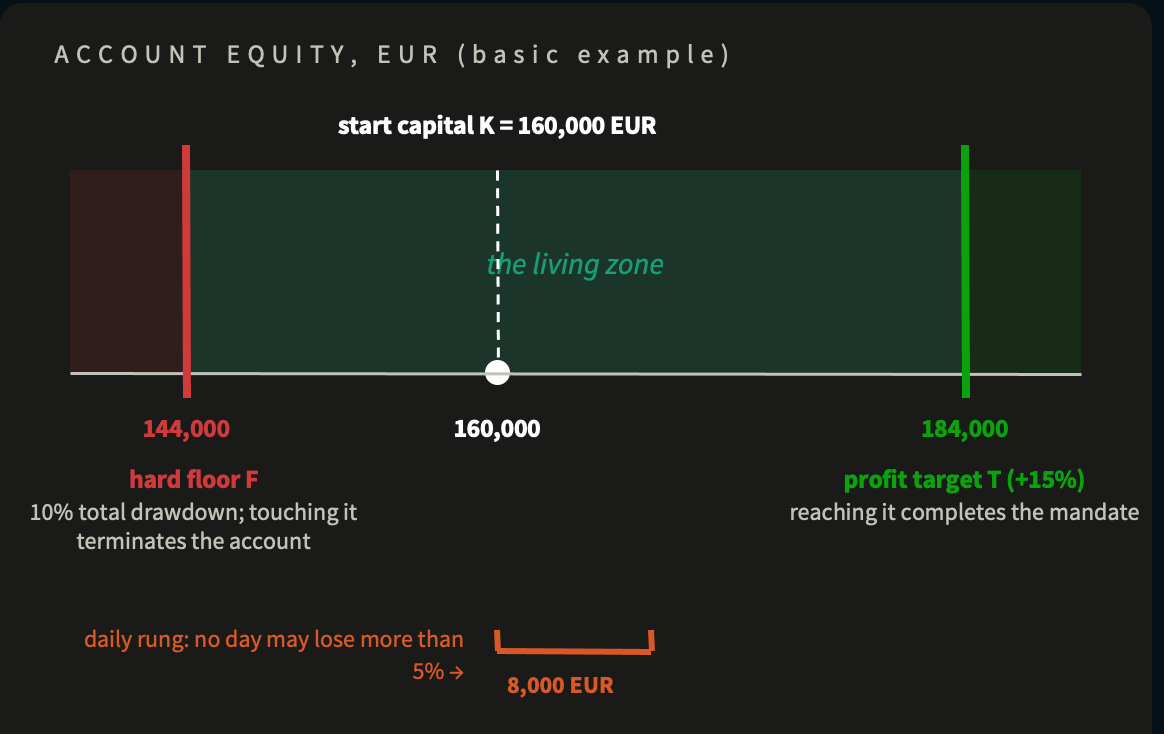
value. A CPPI-inspired cushion-based risk-budgeting
law (after Constant Proportion Portfolio Insurance)
spends risk from the cushion above the mandate’s eq-
uity floor; its entire appetite collapses into one expo-
sure dial. Monthly, a Monte Carlo optimiser re-prices
the dial: 128 Sobol candidates are each simulated un-
der the deployed control law itself, dampeners, breaker,
and costs included, over one common ensemble of 64
moving-block bootstrap scenarios of the trailing year,
and ranked by threshold-tiered survival.
Draft:
One of the interesting takeaways is that we can apply the Nash bargaining score to position sizing, if we assume our algorithmic trading is capped. Algorithms can be instanced in parallel. But if they are all highly volatile, even very liquid hedge funds cannot operationalise them.
Proof Of Concept
The proof of concept combines:
- CPPI (Constant Proportion Portfolio Insurance) against a hard, mandate-defined floor (an FTMO-style prop-challenge rule grid), with the invested fraction of the cushion given by an exposure dial
exposure = min(multiplier * risk_pct/100, 1.50) - a Monte Carlo recalibration of the dial: Sobol quasi-random search over the
(multiplier, risk_pct)plane, each candidate evaluated by a full CPPI equity simulation over block-bootstrapped historical scenarios - a Nash-product ranking (
nash_4p = mean_return * survival² * dd_factor * target_hit_rate) with threshold-tiered survival ranking, whose top bin becomes the deployed dial - a margin-aware circuit breaker (utilisation-triggered flatten at 90 %, re-entry gate at 70 %) and a stack of multiplicative risk dampeners feeding the (EUR) risk budget
Note
The papers are listed as contributions. There is an always changing proprietary layer here, that cannot be shared openly.
Comments and feedback are appreciated.
Contrib
🏧I don’t think of the internet as an ATM that works by tricking people. No coins, no pump and dump, no Telegram or WhatsApp groups with self-serving advice, no social engineering. Nothing I share here should be used to construct trading systems or investment advice. Papers I share
 Aha moments for Quants and ThinkersMarius C